






The Problem
Ohio bill tracking is fragmented and time-consuming
Tracking Ohio legislation often means checking bills, amendments, hearings, votes, and other legislative activity across multiple sources.
When updates are spread across legislative websites, spreadsheets, inboxes, and government tracking tools, it becomes harder to understand what changed and which bills need attention.
Legible brings your Ohio legislative work into one place, helping you find relevant bills, follow activity, and keep your team aligned through a more organized process.
The Solution
Legible gives you a simpler way to keep up with Ohio legislation. Providing the context and information you need to track Ohio legislation, understand developments, and keep your team aligned.
- Find relevant Ohio legislation
- Monitor bill progress and legislative activity
- Receive AI-powered bill summaries
- Organize bills by client, issue, or priority
- Collaborate across teams and stakeholders
- Prepare reports for clients, executives, boards, and associations
- Track hearings and legislative developments in Ohio
One workspace for the Ohio bills that matter to you
Find relevant Ohio legislation beyond exact keyword matches
Bills that affect your organization may not always contain the exact terms your team normally tracks.
Legible helps you find relevant Ohio legislation by identifying bills connected to your clients, organization, issues, and priorities.
Review the bills most relevant to your work without manually searching through every newly introduced measure.
Read the Success Story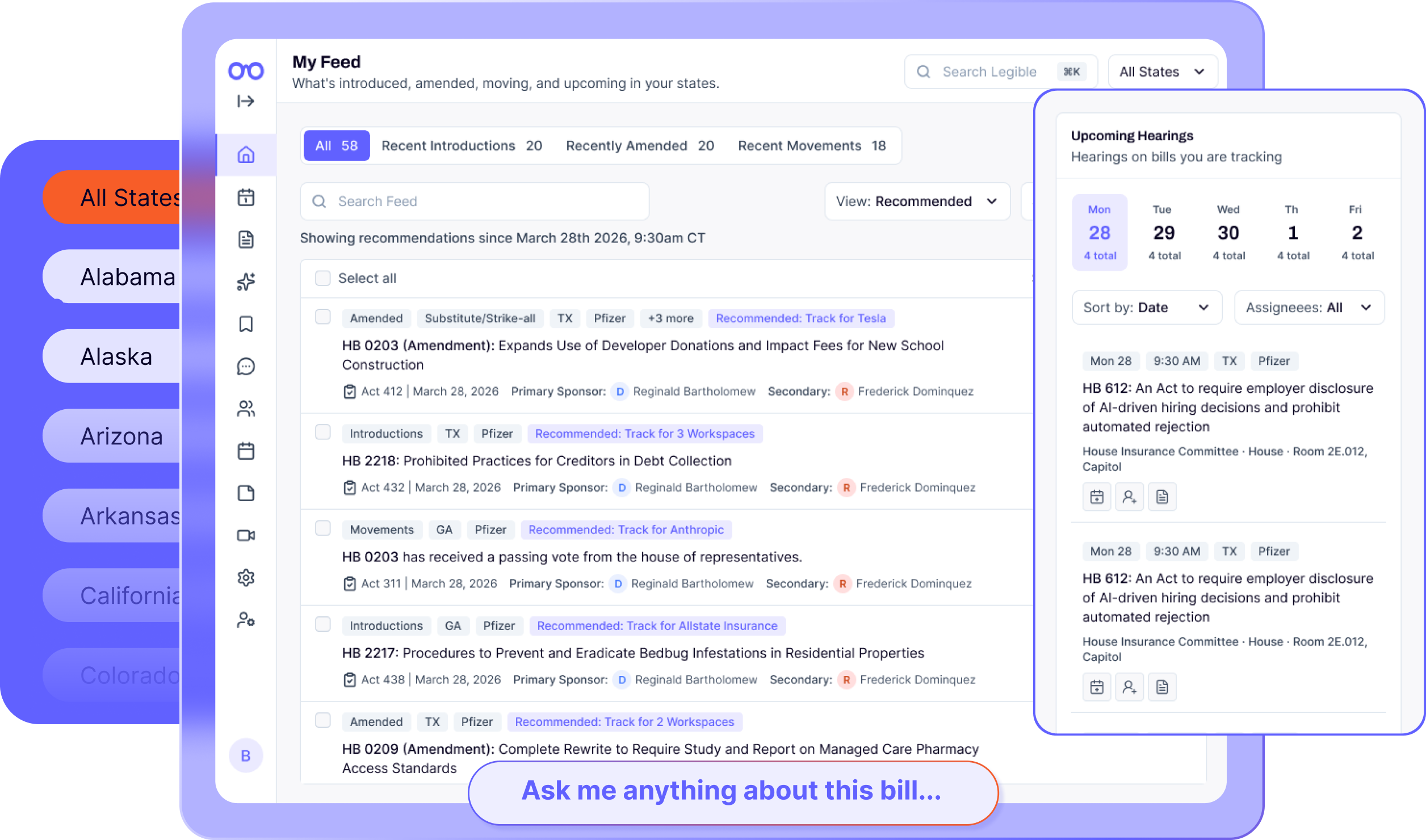
See what changed across the Ohio bills you follow
Follow bill activity, amendments, status changes, hearings, and other developments related to the Ohio legislation your team is tracking.
Instead of reopening every bill or comparing versions manually, use Legible to understand what changed, identify meaningful updates, and focus on the developments that require attention.
Take a Tour
Understand bills faster
Long or technical bills can take time to review and interpret.
Legible provides clear, context-rich summaries and lets you ask questions about a Ohio bill, helping you understand its purpose, provisions, potential impact, and latest activity.
Spend less time working through legislative text and more time preparing your response.
Book a Demo
Your questions about tracking Georgia legislation
Ohio bill-tracking software helps government affairs teams, associations, corporations, nonprofits, and other organizations find and monitor legislation introduced in Ohio .
Legible brings bill discovery, legislative activity, summaries, collaboration, and reporting into one workspace.
Yes. Legible supports legislative tracking across all 50 states, allowing teams to monitor Ohio alongside other jurisdictions from one workspace.
No. Legible supports legislative tracking across all 50 states, allowing teams to monitor Ohio individually or alongside other jurisdictions.
Legible monitors available legislative information and activity so your team can stay informed as tracked Ohio bills are updated.
Legible goes beyond basic bill monitoring by helping teams find relevant Ohio legislation, understand changes, review summaries, collaborate, and prepare reports from one workspace.
Legible helps your team find relevant Ohio bills, monitor changes and activity, understand legislative text, organize bills by issue or priority, and share updates with stakeholders.
Yes. Legible helps you follow amendments, status changes, hearings, votes, and other activity associated with the Ohio bills you are tracking.
Yes. Legible provides AI-powered summaries designed to help you understand the purpose, provisions, and potential implications of Ohio bills more efficiently.
You can also review the underlying legislative text within the platform.
Yes. Teams can organize Ohio bills, add context, coordinate internally, and maintain a shared view of the legislation they are following.
The amount of time saved depends on the number of Ohio bills you follow and your current process.
Legible reduces manual work across bill discovery, monitoring, summarization, collaboration, and reporting.